Whose Glory? Reclaiming the abilities you accidentally credited to your coping mechanisms — and understanding why they were always yours.

The brain is not irrational. It is loyal. And somewhere in your history, it made an equation that felt completely logical at the time — and has been running that equation ever since.
THIS gave me THAT. The evidence was immediate. The relief was real. The nervous system drew its conclusion, filed it, and made it policy.
The problem is not that the brain built the equation. The problem is that the equation was wrong from the beginning. Because the ability was never in THIS. It was already in you — placed by God before THIS ever arrived.


01

THIS = THAT — How Coping Mechanisms Take Credit for God-Given Abilities
The equation forms in a moment. A person reaches for something — a substance, a behaviour, a pattern, a community, a physical practice. It appears to work. The ability surfaces. The moment is navigated.
The brain credits the mechanism. Not the ability that was already present. The mechanism.
From that moment the equation is operational. And to the brain, the nature of the mechanism is irrelevant. It does not distinguish between what is chemically addictive and what is socially celebrated. The architecture of the misattribution is identical regardless of what THIS is.

The list is as long as human experience. The mechanism changes. The equation is always the same. The nervous system, having filed its conclusion, will search for THIS every time the ability is required — because it believes the ability lives there.
It does not. It never did.
02
The Neuroscience of the Misattribution
Across all three categories, peer-reviewed data confirms the same underlying error: the brain confuses the trigger that removes an internal barrier with the source of the capability itself. In neuroscience and behavioural psychology this is studied under source misattribution error and cognitive expectancy bias — the brain experiences a state of high performance and incorrectly logs the external vehicle as the generator of the capability, rather than recognising it as a built-in biological asset (Chow et al., 2018).
Category One — Somatosensory Alterants
When alcohol or another chemical modulator is introduced before a social or performance situation, it acts as a GABA agonist and glutamate antagonist — specifically dampening top-down inhibitory control in the prefrontal cortex (Volkow et al., 2016). The result is that the autonomic threat filter, which had been suppressing the expression of an already-developed ability, is temporarily down-regulated. The vocabulary, the empathy, the social skill — those neural networks were already fully mapped. The substance did not insert them. It merely removed the inhibition that was blocking them.
The brain observes the successful outcome and commits a misattribution of arousal — crediting the chemical modulator rather than the innate cognitive architecture that was already present (Chow et al., 2018). The equation is formed. The ability is filed under the mechanism.
Category Two — High-Arousal Performance Matrices
Inside a competitive environment — a sports team, a debate structure, a high-stakes career track — the architecture of the situation triggers a controlled spike in the sympathetic nervous system, flushing the brain with norepinephrine and dopamine, which sharpens attention and accelerates neural processing speed (Aston-Jones & Cohen, 2005). The individual displays strategic foresight, rapid decision-making, profound leadership.
Because the brain achieves peak performance inside that specific container, it uses neural tagging to link the physiological state of high capability directly to the external environmental cues (Redondo & Tonegawa, 2014). This builds a rigid expectancy bias. When the person is removed from that container — when the uniform comes off, when the career structure changes, when the team dissolves — they experience an immediate drop in perceived capability. The underlying neuroplastic networks for leadership and strategy reside permanently in their own prefrontal cortex. The container did not place them there. It simply provided the conditions in which they fired.
Category Three — Interpersonal Regulation Strategies
Under chronic interpersonal stress, the nervous system automates behavioural loops to maintain relational safety, activating the fawn or flight cascades mediated by the limbic system (Porges, 2022). Over time the person's capacity for deep emotional intelligence, profound sensory processing, and meticulous organisation — innate neurological assets — become so consistently deployed through the fear-based survival strategy that the brain's reward centre logs a false equation.
It attributes the professional excellence to the exhausting, hyper-vigilant coping mechanism rather than recognising that the mechanism simply hijacked an inherent, highly developed cognitive ability. The person concludes: my anxiety and hyper-vigilance are what make me good at this. The ability is real. The source is wrong.
In every category the mechanism is different. The misattribution is identical. The brain cannot tell the difference between what was present and what was the cause. And so it credits the wrong thing — and the equation runs.
03
The Inherited Default
Before a single personal equation is formed, the nervous system arrives with a pre-existing architecture shaped by generations. Through epigenetics, trauma and chronic stress alter how genes are expressed without changing the DNA sequence. A parent's dysregulated stress hormone profile can be biologically transmitted to the offspring — the child arrives with a nervous system pre-set to a higher baseline of alarm (Yehuda & Lehrner, 2018).
Through social learning and behavioural mimicry, children adopt the survival strategies of their primary caregivers (Bandura, 1977). If the parent navigated threat through the fawn response — compliance, performance, keeping oneself invisible — the child copies that strategy as an inherited model for what safety requires.
The nervous system that forms the THIS = THAT equation is not starting from a neutral baseline. It is starting from a pre-loaded set of survival defaults that made certain coping patterns the path of least resistance long before the first personal wound was formed (Bowers & Yehuda, 2016).
The equation did not begin with the individual. But it belongs to no one as identity. It is a nervous system doing its job with the data it was given — from the environment, from the family, and from the generations that preceded both.
04
The Character of God — The Actual Source
To understand why the equation was wrong from the beginning, it is necessary to understand who placed the ability there in the first place — and what that placement reveals about His character.
God has emotions. He experiences grief, joy, anger, compassion. He never acts from the autonomic nervous system response the way a dysregulated human nervous system does. He acts from His character. The emotion informs. The character decides. And His character is the source of every ability He placed in human design.

God experiences anger — and He is slow to it. The emotion registers. The character governs. Every ability placed in a person before their birth was placed by this character — not by circumstance, not by survival necessity, not by any mechanism the person would later reach for to access it.
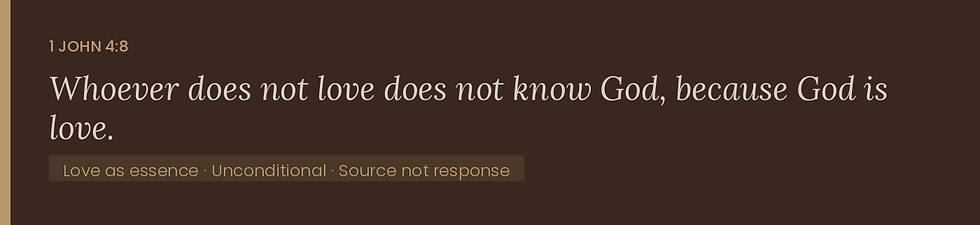
The love spoken of here is agape — not sensual love, not the love of affection or preference, but the unconditional, covenantal, self-giving love that is God's nature and not a response to circumstance. God does not generate agape love in response to favourable conditions. It is His nature — constant, independent of circumstance. What He places in human design comes from this nature. It does not fluctuate. It does not depend on what a person reaches for to access it. It is already there because He is already love.

This passage does not describe a feeling. It describes a series of choices made independently of circumstance — independent of what the nervous system is experiencing, independent of what the environment is producing. This is the character from which every human ability was designed and placed. Not reactive. Not conditional. Not dependent on any external mechanism to activate it.

The source of every ability is immutable. It does not shift with the emotional state. What God placed inside a person before they were born has not changed because of what the person reached for to access it. The ability was always there. The source has not moved.
05
The Proof — Walking in Ability Fully Aware of Its Source
Jesus is the example of what it looks like to walk in ability with full awareness of its authentic source — created in the likeness and image of God, operating from that design under real conditions, with real pressure, in real social and theological confrontation.
Jesus wept at the tomb of Lazarus. He was moved by the grief of those around Him — by the pain of Lazarus's sisters. That is agape love as a verb. Compassion chosen in response to the suffering of others. The emotion was real. And it came from love, not from loss.
He overturned the tables of the money changers. This was not a personal emotional response. The priests and money changers were exploiting the people who were required by law to bring a sacrifice — short-changing them, and filling the Temple with ungodly activity that defiled what God had designed it to be. The anger registered as a road sign pointing to social injustice and the defilement of a holy place. He acted from righteousness on behalf of others — agape love as a verb, choosing what was right over what was socially powerful or personally safe.
In Luke 10, a lawyer stands up publicly to test Him — a deliberate theological trap designed to expose and discredit His teaching. Jesus responded from agape love as a verb and joy as a verb. In answering, He placed a Samaritan — a person entirely excluded from Jewish society — as the one who demonstrated what love in action actually looks like. This was not a comfortable illustration. It was a direct confrontation of the social injustice and discrimination embedded in the religious and cultural structure of the day. He chose what was true over what was socially accepted. He chose the excluded over the hierarchy.
When the mind equates an external activity or expression as the cause of an ability rather than recognising that the ability was placed by God, the brain does not log a passive memory. It fundamentally alters its predictive map. It marks that external activity as the mandatory access key to the ability — and through Long-Term Potentiation, the neural pathways connecting the activity to the reward centre are physically reinforced and maintained as critical infrastructure (Seeley, 2019).
The brain is almost entirely predictive. According to the Predictive Processing Framework, it uses past data to construct pre-set rules to navigate current stress (Friston, 2010). If the established rule is Activity X = access to my ability, the brain will refuse to deploy that ability without the trigger. The moment the environment demands the characteristic, the predictive brain scans the historical log, finds the neural tag, and generates an intense craving or behavioural impulse drawing the person backward — because it has encoded a false neurological rule that the ability cannot be generated independently.
When the external activity is no longer accessible, the biological system suffers a three-part collapse — because the mind believes it has lost the source of its capacity.
The brain experiences a massive prediction error — the prior cannot be fulfilled, the amygdala fires instantly, flooding the system with cortisol and adrenaline, and the body registers the missing access key as a literal threat to survival (Clark, 2013). Losing an external activity fused with ability triggers the same neural pathways as relational grief — the anterior cingulate cortex activates, causing a visceral sense of loss, deficiency, and mourning over the perceived lost capacity (Eisenberger, 2012). And because the system is flooded with stress hormones, the prefrontal cortex — the seat of executive function and voluntary self-control — goes offline. The lower limbic system takes over. Self-control collapses (Volkow et al., 2016).
Stress. Grief. Loss of self-control. Not because the ability was ever in the activity. But because the brain was defending an equation that was wrong from the moment it was formed.
06
Abilities Done Repetitively Become Talents
The brain is born with a baseline genetic blueprint — an innate cognitive and somatic architecture. Before external stress shapes behaviour, the nervous system already possesses pre-programmed capacities for connection, reasoning, resilience, and expression. The wound does not create these capacities. It merely encounters them (Plomin & Von Stumm, 2018).
When a raw, God-given ability is practiced intentionally and repeatedly, the brain undergoes myelination — a fatty sheath forms around the neural pathways responsible for that ability, accelerating electrical signals and transforming a conscious, effortful skill into an automated, high-level talent (Fields, 2008).
The ability was already there. Repetition does not create it. Repetition refines it into a talent.
07
The Glory Was Never the Mechanism's

Every ability that surfaced in those moments — the ones credited to the mechanism, the ones that felt inaccessible without it — came from above. Not from the substance. Not from the behaviour. Not from the pattern, the team, the practice, or the performance. From above. From a Father who does not change like shifting shadows.

Prepared in advance. Before the wound. Before the equation. The ability to do the work was already placed. The handiwork was already complete before the story of survival ever began.
Every ability was received. It was not generated by the mechanism. It was not accessed because of the behaviour. It was received — from above, from the Father of lights, prepared in advance, placed in the design before any coping mechanism was ever formed.

What changes when the credit goes back to where it always belonged is not the ability. What changes is the authority from which a person operates.
The glory was always His. The ability was always yours. And the equation that stood between those two truths was always wrong.
Comments